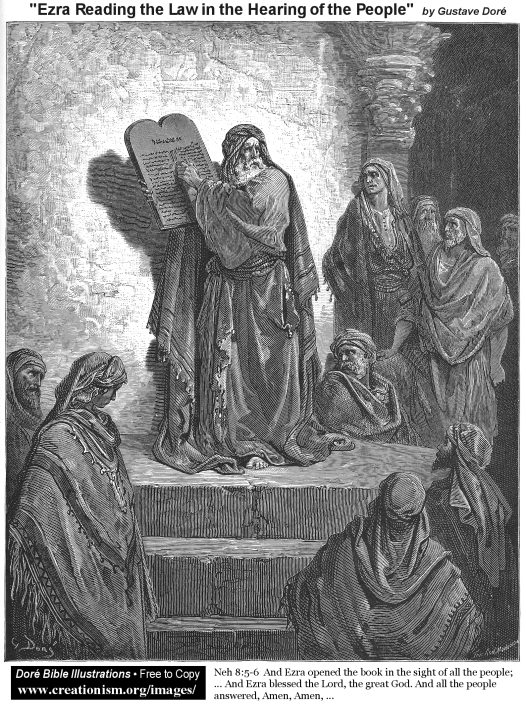
And all the people gathered as one man at the square which was in front of the Water Gate, and they asked Ezra the scribe to bring the book of the law of Moses which the Lord had given to Israel. Then Ezra the priest brought the law before the assembly of men, women and all who could listen with understanding, on the first day of the seventh month. He read from it before the square which was in front of the Water Gate from early morning until midday, in the presence of men and women, those who could understand; and all the people were attentive to the book of the law. Ezra the scribe stood at a wooden podium which they had made for the purpose. And beside him stood Mattithiah, Shema, Anaiah, Uriah, Hilkiah, and Maaseiah on his right hand; and Pedaiah, Mishael, Malchijah, Hashum, Hashbaddanah, Zechariah and Meshullam on his left hand. Ezra opened the book in the sight of all the people for he was standing above all the people; and when he opened it, all the people stood up. Then Ezra blessed the Lord the great God. And all the people answered, “Amen, Amen!” while lifting up their hands; then they bowed low and worshiped the Lord with their faces to the ground. Also Jeshua, Bani, Sherebiah, Jamin, Akkub, Shabbethai, Hodiah, Maaseiah, Kelita, Azariah, Jozabad, Hanan, Pelaiah, the Levites, explained the law to the people while the people remained in their place. They read from the book, from the law of God, translating to give the sense so that they understood the reading. Then Nehemiah, who was the governor, and Ezra the priest and scribe, and the Levites who taught the people said to all the people, “This day is holy to the Lord your God; do not mourn or weep.” For all the people were weeping when they heard the words of the law. Then he said to them, “Go, eat of the fat, drink of the sweet, and send portions to him who has nothing prepared; for this day is holy to our Lord. Do not be grieved, for the joy of the Lord is your strength.” So the Levites calmed all the people, saying, “Be still, for the day is holy; do not be grieved.” All the people went away to eat, to drink, to send portions and to celebrate a great festival, because they understood the words which had been made known to them."
 On the positive side...
1. This is one illustration from Scripture of how the Word was presented to people. Several things in this passage (the people standing at the reading of the Word, perhaps the podium, etc.) emphasize a high view of Scripture. I think our Baptist churches do a relatively good job of emphasizing the priority of the Word. This is something we need to hold on to tightly.
2. We desire to have people apply and respond to the Word (though we seldom know what decision they have made and are unable to hold them accountable).
On the other side...
1. Maybe we are products of the Enlightenment. Our preaching is mostly propositional. The pastor has an idea he wishes to convey to the inactive, non-participatory audience. He uses three points (sometimes alliterated) and a few illustrations to "prove" his point, and the audience "sits back" to consider how they will respond to his proposition. Our congregations are often postured as observers or critics instead of interacters. (Though we all know we should consider what we are taught as the Bereans did.)
2. The congregation (in our culture) has been conditioned to react unemotionally. The people in Nehemiah 8 responded to God's Word both emotionally and physically with their voices, their hands, their bodies, their postures, and their tears.
3. In this passage, there were many in "leadership" trained to immediately help the people translate, apply, and understand what they were hearing. It sounds to me like this was done in a relative "small group" format while the people were still standing. After the teaching of God's Word, these men were somehow positioned throughout the assembly to talk to the people about what they had just heard. Every time God's Word is presented, we should make a decision about how we will change our lives based on what we have heard (James 1).
4. I have seldom seen people in my churches filled with the kind of grief at disobedience or joyful response that these people demonstrated upon hearing and understanding God's Word. Holiness is generally associated with heaviness or thoughtfulness, not overwhelming joy.
I was recently at a conference where a church-planting pastor told us how he has every member of his congregation fill out a "Com card" (response card) at the end of the service. About ten minutes of time was built into the service for the people to answer a question he asked them in relation to his message. These were all turned in to the pastor, so that he (and the individuals themselves) could map spiritual progress. He also gives a tangible corresponding "thing" (bracelet, rock, etc.) to every member of his congregation for every series he does to serve as a memory tool for what they have learned. It may be that the way we present information and order our services needs to change to adapt to a Postmodern world. We may need more movement, more emotion, more visual illustration, and more interaction to communicate effectively.
 On the positive side...
1. This is one illustration from Scripture of how the Word was presented to people. Several things in this passage (the people standing at the reading of the Word, perhaps the podium, etc.) emphasize a high view of Scripture. I think our Baptist churches do a relatively good job of emphasizing the priority of the Word. This is something we need to hold on to tightly.
2. We desire to have people apply and respond to the Word (though we seldom know what decision they have made and are unable to hold them accountable).
On the other side...
1. Maybe we are products of the Enlightenment. Our preaching is mostly propositional. The pastor has an idea he wishes to convey to the inactive, non-participatory audience. He uses three points (sometimes alliterated) and a few illustrations to "prove" his point, and the audience "sits back" to consider how they will respond to his proposition. Our congregations are often postured as observers or critics instead of interacters. (Though we all know we should consider what we are taught as the Bereans did.)
2. The congregation (in our culture) has been conditioned to react unemotionally. The people in Nehemiah 8 responded to God's Word both emotionally and physically with their voices, their hands, their bodies, their postures, and their tears.
3. In this passage, there were many in "leadership" trained to immediately help the people translate, apply, and understand what they were hearing. It sounds to me like this was done in a relative "small group" format while the people were still standing. After the teaching of God's Word, these men were somehow positioned throughout the assembly to talk to the people about what they had just heard. Every time God's Word is presented, we should make a decision about how we will change our lives based on what we have heard (James 1).
4. I have seldom seen people in my churches filled with the kind of grief at disobedience or joyful response that these people demonstrated upon hearing and understanding God's Word. Holiness is generally associated with heaviness or thoughtfulness, not overwhelming joy.
I was recently at a conference where a church-planting pastor told us how he has every member of his congregation fill out a "Com card" (response card) at the end of the service. About ten minutes of time was built into the service for the people to answer a question he asked them in relation to his message. These were all turned in to the pastor, so that he (and the individuals themselves) could map spiritual progress. He also gives a tangible corresponding "thing" (bracelet, rock, etc.) to every member of his congregation for every series he does to serve as a memory tool for what they have learned. It may be that the way we present information and order our services needs to change to adapt to a Postmodern world. We may need more movement, more emotion, more visual illustration, and more interaction to communicate effectively.