Wednesday, August 16, 2006

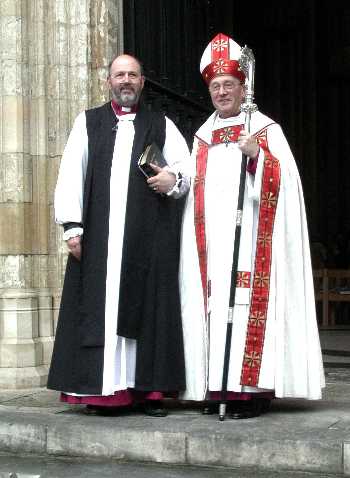
What's NT Wright All About?

Frankly, if you can tell me what N.T. Wright is all about after reading these quotes, please do...

From a BBC interview:
Q How are you on the Virgin Birth?

A Well let me first say David has routinely been misquoted, and I don't want to sign up to the various legends that surround him, and he's an enormously gifted man who gave a huge amount to the diocese where I'm now serving and, and I'm proud to be one of his successors. I have come to see the stories in Matthew and Luke about the Virgin Birth as stories which are as historians often find, so strange in themselves, that if you tried to figure out how those stories could've come about unless there was substantial truth at the heart of it, it's actually harder to do that then to see them as I do, as people saying 'This is really very odd. We know there are lots of stories like this out there in the pagan world.' I mean Augustus - there were stories about a miraculous birth and so on, and round the same time. And the Christians were standing over against that sort of pagan belief, so they wouldn't have pushed in that route and risked Mary's reputation being sullied - you know as you find in Matthew's Gospel and so on - unless it actually was so. But I have to say my belief about Jesus does not as somebody said recently, rest on the Virgin Birth, because John's Gospel doesn't mention it or maybe one hint, but that's very controversial. The Letter to the Hebrews which has this wonderfully high view of Jesus doesn't mention it. And particularly St Paul doesn't mention it - and it's Paul who is our earliest writer and has the most fantastic view of Jesus as the Incarnate Word etc, etc. , and he doesn't mention the Virgin Birth at all.
...
Q Do you think that Christianity is in any way a more exclusive or truer religion than the others?

A It's interesting to say 'more exclusive' and 'truer' because of course, the word 'exclusive' is a 'boo word' at the moment. So saying it's both exclusive and true might be a little tricky. I want to say that Jesus matters supremely. Nobody says that Mohammed rose again from the dead. Nobody said that Krishna died to save them from evil and sin and so on. And these claims are not simply on all fours with claims made in other world views, other religious traditions. They're different in kind as well as in content. And it's my belief partly because I am captivated by this person Jesus, and delighted to be so, and also because as a scholar I've had the privilege of looking at the evidence extremely thoroughly, and I find those two strands of history and faith simply coming together and questioning each other, challenging each other, but always coming back with more depth and more passion and more power actually to change lives.
...
Q So we won't all be saved?

A According to the New Testament there is a real possibility…

Q No according to you … I want you to tell me.

A … I'm sorry - I'm a Christian theologian - therefore the New Testament is where I must start. And yes I'm affirming this. That there is a real possibility of loss but just at the point where we think the New Testament is going to say 'Bang - there it is. We're going to tell you who's in, who's out,' there are hints and vague suggestions, that actually yes, there will be those who will look God in the face and say 'Sorry that's not for me and I'm going to go the other way,' and that God will ratify that decision, because we are human beings with the dignity of making those decisions - that there are many others who are being drawn towards the light, many others who are being wooed into the love of God. And that it's not up to me to say exactly where that line is drawn on a page. I do believe that there is a real possibility and actuality of final loss, but that immortality is this strange, new gift. It's not that, as Plato said, we've all got an immortal soul and we're all just going to carry on. No, that's not the Christian belief. The Christian belief is that God promises this as a fresh gift to be received gratefully. And that means, as I think it was John Polkinghorn who said that when we die, God will 'download our software onto His hardware until the time when He gives us new hardware to run the software again for ourselves.' Now…

A Word from Jonathan Edwards

From Jonathan Edwards diary Saturday morning, January 12, 1723
I have this day, solemnly renewed my baptismal covenant and self-dedication, which I renewed, when I was taken into the communion of the church. I have been before God, and have given myself, all that I am and have, to God; so that I am not, in any respect, my own. I can challenge no right in this understanding, this will, these affections, which are in me. Neither have I any right to this body, or any of its members — no right to this tongue, these hands, these feet; no right to these senses, these eyes, these ears, this smell, or this taste. I have given myself clear away, and have not retained any thing, as my own. I gave myself to God, in my baptism, and I have been this morning to him, and told him, that I gave myself wholly to him. I have given every power to him; so that for the future, I’ll challenge no right in myself, in no respect whatever. I have expressly promised him, and I do now promise Almighty God, that by his grace, I will not. I have this morning told him, that I did take him for my whole portion and felicity, looking on nothing else, as any part of my happiness, nor acting as if it were; and his Law, for the constant rule of my obedience; and would fight, with all my might, against the world, the flesh and the devil, to the end of my life; and that I did believe in Jesus Christ, and did receive him as a Prince and Savior; and that I would adhere to the faith and obedience of the Gospel, however hazardous and difficult, the confession and practice of it may be; and that I did receive the blessed Spirit, as my Teacher, Sanctifier, and only Comforter, and cherish all his motions to enlighten, purify, confirm, comfort and assist me. This, I have done; and I pray God, for the sake of Christ, to look upon it as a self-dedication, and to receive me now, as entirely his own, and to deal with me, in all respects, as such, whether he afflicts me, or prospers me, or whatever he pleases to do with me, who am his. Now, henceforth, I am not to act, in any respect, as my own. "


From http://fpcj.blogspot.com/

Tuesday, August 15, 2006

Prisoner of Narnia? Part Deux

From Adam Gopnik's New Yorker article
I was multitasking over the weekend. While my ipod was blasting the melodious tunes of The Untitled Hymn by Chris Rice I was reading a bit from C.J. Mahaney’s The Cross Centered Life. Mahaney wrote at lengths on the dangers of legalism. Simply put, legalism is trying in ones own efforts to gain favor with God. I know legalism because I was one. I can remember sitting in the basement of my house praying for long periods of time to try to salve some heinous sin that I had just committed (probably not doing my devotions). I just wanted God to know that it was going to be different this next time. I wasn’t going to mess it up again… right… How many years I missed out on the glory of it all! That aside, something struck me as I listened to Chris Rice. I really doubt Chris Rice is a legalist. In fact, legalists don’t write music, do they? They don’t produce art or poetry either, do they?

Now back to Lewis. Gopnik couldn’t be more wrong. Let my address some of the quotes from the article:

The first charge: Lewis felt the burden to reinfect his stories with belief.
Yet, if these words are a declaration of faith, they are also a document of bad conscience. For, throughout his own imaginative writing, Lewis is always trying to stuff the marvellous back into the allegorical—his conscience as a writer lets him see that the marvellous should be there for its own marvellous sake, just as imaginative myth, but his Christian duty insists that the marvellous must (to use his own giveaway language) be reinfected with belief. He is always trying to inoculate metaphor with allegory, or, at least, drug it, so that it walks around hollow-eyed, saying just what it’s supposed to say."
Gopnik

I think if you read Lewis you understand that he never felt captive by the truth of gospel but inspired by it. In fact, for Lewis writing myth is always less than, and pointing to, Christ. Lewis saw grace in Balder because it acted as a signpost. Truth was what inspired because truth was what mattered. Secularists see value in the process or the medium, Lewis saw the medium as grace that pointed to the truth. So I reject the idea that Lewis was bridled by institutions. To Lewis, marvelous was Christ, and that made all the signposts to him more glorious!

Now as myth transcends thought, Incarnation transcends myth. The heart of Christianity is a myth which is also a fact. The old myth of the Dying God, without ceasing to be myth comes down from the heaven of legend and imagination to the earth of history. It happens - at a particular date, in a particular place, followed by definable historical consequences. We pass from a Balder or an Osiris, dying nobody knows when or where, to a historical Person crucified (it is all in order) under Pontius Pilate. By becoming fact it does not cease to be myth: that is the miracle...Those who do not know that this great myth became Fact when the Virgin conceived are, indeed, to be pitied. But Christians also need to be...reminded that what became Fact was a Myth, that it carries with it into the world of Fact all the properties of a myth. God is more than a god, not less; Christ is more than Balder, not less. We must not be ashamed of the mythical radiance resting in our theology."
C.S. Lewis

Second Charge: The “religious part” diminishes the emotional power
The emotional power of the book, as every sensitive child has known, diminishes as the religious part intensifies. The most explicitly religious part of his myth is the most strenuously, and the least successfully, allegorized. Aslan the lion, the Christ symbol, who hasexasperated generations of freethinking parents and delighted generations of worried Anglicans, is, after all, a very weird symbol for that famous carpenter’s son—not just an un-Christian but in many ways an anti-Christian figure."
Gopnik
Because Gopnik says “every child knows” this does not mean it’s true. I suspect Gopnik’s own worldview has more to do with this assertion than anything. This is why those who share his worldview are apt to agree. I for one am struck breathless when I read the character of Aslan. He is Narnia to me. What I see in Aslan is a manifestation of theology; I see a parable. As one who has experienced the overwhelming glory of the mercies of God, I’m drenched with gratitude. I love Aslan because I love the gospel.
Third Charge: Jesus should be a donkey, not a lion.
Yet a central point of the Gospel story is that Jesus is not the lion of the faith but the lamb of God, while his other symbolic animal is, specifically, the lowly and bedraggled donkey. The moral force of the Christian story is that the lions are all on the other side. If we had, say, a donkey, a seemingly uninspiring animal from an obscure corner of Narnia, raised as an uncouth and low-caste beast of burden, rallying the mice and rats and weasels and vultures and all the other unclean animals, and then being killed by the lions in as humiliating a manner as possible—a donkey who reëmerges, to the shock even of his disciples and devotees, as the king of all creation—now, that would be a Christian allegory. A powerful lion, starting life at the top of the food chain, adored by all his subjects and filled with temporal power, killed by a despised evil witch for his power and then reborn to rule, is a Mithraic, not a Christian, myth. "
Gopnik

This is in some regards the saddest of all of the charges. Gopnik truly has no grasp on the paradoxical union that was God, a man. The character and nature of Christ is the most stunning absurdity in the history of the world. Philippians 2 reads this way.
Who, although He existed in the form of God, did not regard equality with God a thing to be grasped, but emptied Himself, taking the form of a bond-servant, and being made in the likeness of men. Phil 2:6-7

This is the truth, that Gopnik simply cannot grasp. Christ was indeed a lion; he was God himself. And he postured himself as a servant for our debt. I cannot think of a better creature to illustrate this inequity, this devastating irony, than a the king of the beasts.
For poetry and fantasy aren’t stimulants to a deeper spiritual appetite; they are what we have to fill the appetite. The experience of magic conveyed by poetry, landscape, light, and ritual, is . . . an experience of magic conveyed by poetry, landscape, light, and ritual. To hope that the conveyance will turn out to bring another message, beyond itself, is the futile hope of the mystic. Fairy stories are not rich because they are true, and they lose none of their light because someone lit the candle. It is here that the atheist and the believer meet, exactly in the realm of made-up magic. Atheists need ghosts and kings and magical uncles and strange coincidences, living fairies and thriving Lilliputians, just as much as the believers do, to register their understanding that a narrow material world, unlit by imagination, is inadequate to our experience, much less to our hopes.
Gopnik
Gopnik, is wrong. Fairy stories are indeed rich, but only through common grace. Grace gives man creativity and passion. But all such pleasures are only signposts to a greater one. This is what Lewis knew, sadly Gopnik does not.

Labels

Just last night my family attended a neighborhood potluck. We met many young couples our age. It was a great experience, but very discouraging for me. We met several people who had been raised in Baptist or baptistic churches and now attend various non-denominational churches here in our town. Most of the non-denom churches in town are really right on about the gospel, and I praise God for the growth they are experiencing. I don't know, though, that they are teaching their people good doctrine and helping them to have spiritual depth. Most also have very generic names without any real description of what they believe. I've struggled with this and sometimes think "why don't we all just lose the labels so that we can be more attractive?" (I'd love to hear your thoughts on this, by the way.)
Then, this morning I was talking on the phone to a neighbor who goes to the Christian Reformed church here in town. She's really searching God's Word and starting to question her church doctrine. She said, "Amy, I think I need to talk to you sometime about baptism. I was baptized as a baby, but I think I need to be baptized again. " We had a good talk about covenant theology, baptism, etc. She's in a difficult position because, in order to switch to a different church, her husband would also have to change what he believes on some things. She is concerned about raising her kids to practice exactly what the Bible says. I do not know what will become of this, but I was encouraged to think that I have been given the opportunity to think through the practical implications of Bible doctrine and to live like I believe. How refreshing and freeing to be able to attend a church that teaches what I believe. And, for today, I'm glad Heather knew that I attended a "baptist" church because she knew who to come to when she had questions. She trusted I would search the Scriptures with her to help her come to the truth. Praise God.

Monday, August 14, 2006

Songs of the Cross

'Twas I that shed the sacred Blood,
I nailed him to the Tree,
I crucified the Christ of God;
I joined the mockery.
And of that shouting mutitude
I feel that I am one;
And in that din of voices rude
I recognize my own.
Around the Cross the throng I see
That mock the Sufferer's groan
Yet still my voice it seems to be,
As if I mocked alone.


Horatius Bonar


In evil long I took delight
Unawed by shame or fear;
Till a new object struck my sight
And stopped my wild career.
I saw one hanging on a tree
In agonies and blood;
Who fixed his languid eyes on me
As near his cross I stood.
Sure never till my latest breath
Can I forget that look;
It seemed to charge me with his death
Though not a word he spoke
My conscience felt and owned the guilt
And plunged me in despair;
I saw my sins his blood had spilt
And helped to nail him there.
Alas, I knew not what I did
But now my tears are vain;
Where shall my trembling sould be hid?
For I the Lord have slain.
A second look he gave which said
"I freely all forgive;
This blood is for thy ransom paid
I died that thou mayest live."
Thus while his death my sin displays
In all its blackest hue;
Such is the mystery of grace,
It seals my pardon too.
With pleasing grief and mournful joy
My spirit now is filled;
That I should such a life destroy
Yet live by him I killed.

John Newton

Join the Club

Get your Daniel Wallace phanclub t-shirts here.

http://www.cafepress.com/centuri0n/1720400

Prisoner of Narnia?

The New Yorker: A Critic at Large
Prisoner of Narnia, how C.S. Lewis Escaped
by Adam Gopnik


If you are a C.S. Lewis fan you need to
read this article. I'll update my analysis of it later. Indeed very interesting in light of our conversations.

When we sit down to write a romance, then, we make up elves and ghosts and wraiths and wizards, in whom we don’t believe but in whom we enclose our most urgent feelings, and we demand that the world they inhabit be consistent and serious.

Yet, if these words are a declaration of faith, they are also a document of bad conscience. For, throughout his own imaginative writing, Lewis is always trying to stuff the marvellous back into the allegorical—his conscience as a writer lets him see that the marvellous should be there for its own marvellous sake, just as imaginative myth, but his Christian duty insists that the marvellous must (to use his own giveaway language) be reinfected with belief. He is always trying to inoculate metaphor with allegory, or, at least, drug it, so that it walks around hollow-eyed, saying just what it’s supposed to say.
...
What is so moving about the Narnia stories is that, though Lewis began witha number of haunted images—a street lamp in the snow, the magic wardrobe itself, the gentle intelligent faun who meets Lucy—he never wrote down to, or even for, children, except to use them as characters, and to make his sentences one shade simpler than usual. He never tries to engineer an entertainment for kids. He writes, instead, as real writers must, a real book for a circle of readers large and small, and the result is a fairy tale that includes, encyclopedically, everything he feels most passionate about: the nature of redemption, the problem of pain, the Passion and the Resurrection, all set in his favored mystical English winter-and-spring landscape. Had he tried for less, the books would not have lasted so long. The trouble was that though he could encompass his obsessions, he could not entirely surrender to his imagination. The emotional power of the book, as every sensitive child has known, diminishes as the religious part intensifies. The most explicitly religious part of his myth is the most strenuously, and the least successfully, allegorized. Aslan the lion, the Christ symbol, who has exasperated generations of freethinking parents and delighted generations of worried Anglicans, is, after all, a very weird symbol for that famous carpenter’s son—not just an un-Christian but in many ways an anti-Christian figure.

Yet a central point of the Gospel story is that Jesus is not the lion of the faith but the lamb of God, while his other symbolic animal is, specifically, the lowly and bedraggled donkey. The moral force of the Christian story is that the lions are all on the other side. If we had, say, a donkey, a seemingly uninspiring animal from an obscure corner of Narnia, raised as an uncouth and low-caste beast of burden, rallying the mice and rats and weasels and vultures and all the other unclean animals, and then being killed by the lions in as humiliating a manner as possible—a donkey who reëmerges, to the shock even of his disciples and devotees, as the king of all creation—now, that would be a Christian allegory. A powerful lion, starting life at the top of the food chain, adored by all his subjects and filled with temporal power, killed by a despised evil witch for his power and then reborn to rule, is a Mithraic, not a Christian, myth.
...
For poetry and fantasy aren’t stimulants to a deeper spiritual appetite; they are what we have to fill the appetite. The experience of magic conveyed by poetry, landscape, light, and ritual, is . . . an experience of magic conveyed by poetry, landscape, light, and ritual. To hope that the conveyance will turn out to bring another message, beyond itself, is the futile hope of the mystic. Fairy stories are not rich because they are true, and they lose none of their light because someone lit the candle. It is here that the atheist and the believer meet, exactly in the realm of made-up magic. Atheists need ghosts and kings and magical uncles and strange coincidences, living fairies and thriving Lilliputians, just as much as the believers do, to register their understanding that a narrow material world, unlit by imagination, is inadequate to our experience, much less to our hopes.

The religious believer finds consolation, and relief, too, in the world of magic exactly because it is at odds with the necessarily straitened and punitive morality of organized worship, even if the believer is, like Lewis, reluctant to admit it. The irrational images—the street lamp in the snow and the silver chair and the speaking horse—are as much an escape for the Christian imagination as for the rationalist, and we sense a deeper joy in Lewis’s prose as it escapes from the demands of Christian belief into the darker realm of magic. As for faith, well, a handful of images is as good as an armful of arguments, as the old apostles always knew.

Also in the article was this quote:
The same thing has happened to G. K. Chesterton: the enthusiasts are so busy chortling and snickering as their man throws another right hook at the rationalist that they don’t notice that the rationalist isn’t actually down on the canvas; he and his friends have long since left the building.

Friday, August 11, 2006

When Witnessing to Muslims

SAVE THIS LINK
Thabiti Anyabwile is quickly becoming one of my favorite bloggers. His series is completed on Witnessing to Muslims. This would be a good one to print and keep.

When Witnessing to Muslims... Know the Gospel

When Witnessing to Muslims... Renounce Fear

When Witnessing to Muslims... Defend the Bible

When Witnessing to Muslims... Get Personal

When Witnessing to Muslims... Get to Jesus

When Witnessing to Muslims... Get to Jesus (2)

When Witnessing to Muslims... Be Hospitable

When Witnessing to Muslims... Remember...

Perhaps the greatest challenge to effective gospel outreach to Muslim friends and neighbors is fear. It’s sometimes a subtle fear that appears in our assumptions (“they won’t be interested” or “it’s useless trying to reach out”) and sometimes appears in more visceral ways. But fear pervades our interactions with men and women who practice Islam.


But God did not give us a spirit of fear or timidity but of power, of love, and of self-discipline (2 Tim. 1:7). This truth needs desperately to be remembered when evangelism and Muslim are used in the same breath.

There are four fears that most Christians tend to experience when it comes to sharing the Gospel with Muslims.

1. Fear of Terrorists: Let’s face it; a great number of us think “terrorist” or “potential terrorist” when we see an Arab, in general, and an Arab Muslim in particular. The images that inform this fear are plentiful: images of 9/11, of bearded men with head scarves, of angry Arabs protesting cartoons, of masked militia wielding automatic weapons and rocket launchers, of young Arab boys throwing Molotov cocktails and rocks at tanks, of dreaded suicide bombers maiming and killing bystanders and civilians.

The almost daily deluge of these images fills us with suspicion and fear and causes us to hesitate in sharing, lest we talk with an actual terrorist and somehow end up on their “hit list.” This fear blinds us to the person’s great need of a Savior by focusing us on ourselves, our vain lust for security and safety. So, what if the person is a terrorist? Aren’t we better of rejoicing at the prospect of speaking with a terrorist and by God’s omnipotent aid actually seeing them converted from such hate-filled darkness to the joy and love-filled light of Christ? The Christian’s “war against terror” is the warfare we wage to spread the gospel to all—including folks we fear might be terrorists.

Please Read on

Wednesday, August 09, 2006

Up All Night Thinking About Evangelism

From Pure Church, by Thabiti Anyabwile

But there's still the "why" of my evangelistic duldrums. Why am I not doing more already?

I think I need to deepen my love for the Savior and the Good News of the Savior. I think I need to contemplate more deeply the majesty, person, and work of our Lord. I also need to think more deeply and pray more fervently about the perishing souls that surround me. I can't say I consistently view people the way Jesus views them. My valuation of their souls is too low. I think I lack urgency. I think I "trust in God's sovereignty" in the wrong way at times. I need to repent.

Two hours later, here's my initial plan:

  • Meet the neighbors and schedule dinner with them in the first 30 days.
  • Pray for opportunities and a ready mind.
  • Find a new barber (a bro. needs a cut), preferrably one with decent skills but not a Christian.
  • Phone the brother of a friend who lives on the island and is not a believer. Do lunch.
  • Pray that the Lord would send laborers into the harvest and for friends on the field.
  • Think through an initial strategy for training and encouraging others in evangelism.
  • Adjust my reading plan to focus more intently on the Savior and the gospel (I'd welcome recommendations).
  • Pick up those two biographies I've been neglecting (The Life and Diary of David Brainerd and To the Golden Shore).
  • Pray, pray, pray for a fervent spirit and abiding love for the lost.

What am I missing?

Tuesday, August 08, 2006

Humility: True Greatness

I just finished maybe the most important book I have read in a long time, Humility True Greatness, by C.J. Mahaney. It is 175 pages but you could read it in a couple (few?) hours. The deception of this sin is terrifying. Please, for those of you who know me well, I'm asking that you will hold me accountable and point out my pride. God's glory is at stake in my life. Here's a sample of some things you'll find in the book from Sovereign Grace Ministries.

This Is The One To Whom I Will Look
How to Daily Weaken Pride and Cultivate Humility

C.J. Mahaney

But this is the one to whom I will look: he who is humble and contrite in spirit and trembles at my word. Isaiah 66:2
Humble yourselves, therefore, under the mighty hand of God so that at the proper time he may exalt you. 1 Peter 5:6
1) Begin the day acknowledging your dependence upon God and your confidence in God.

Have you realized that most of your unhappiness in life is due to the fact that you are listening to yourself instead of talking to yourself?”
D Martin Lloyd Jones

Set the tone for your day by immediately speaking truth to yourself rather than listening to lies from yourself.
Let the truth of person and substitutionary work of Jesus Christ for your sins be where you begin your thoughts, meditation and declarations each day.

2) At the outset of each day express specific gratefulness to God.

Thankfulness is a soil in which pride does not easily grow.”
John Stott

An ungrateful person is a proud person. Throughout the day be an alert and thankful observer of the post it notes provided by God reminding you of common and saving grace. Remember, whatever grace you receive from God is far more than you deserve and whatever pain and suffering you experience is far less than you deserve.

3) Practice the Spiritual Disciplines
When we fail to wait prayerfully for God’s guidance and strength, we are saying, with our actions if not our lips, that we do not need him.”
Charles Hummel

Practicing the spiritual disciplines is daily declaration and demonstration of my need for God and my dependence upon God.

4) Seize Your Daily Commute as an Opportunity to Mediate on Scripture.
Blessed is the man who walks not in the counsel of the wicked, nor stands in the way of sinners, nor sits in the seat of scoffers: but his delight is in the law of the Lord and on his law he meditates day and night."
Psalm 1:1-2

5) Throughout Each Day Cast Your Cares Upon Him.
Humble yourselves...casting ALL your anxieties on him, because he cares for you."
1 Peter 5:6-7

The humble are care free. Where there is worry, anxiety, anxiousness there is pride. Humility

The root of worry and anxiety is self-sufficiency. God gives grace to those who humble themselves and cast each and every care on him.

The effect of this act is the weakening of pride and the experience of peace and joy.

6) At the End of the Day Transfer the Glory to God
When we have done anything praiseworthy, we must hide ourselves under the veil of humility, and transfer the glory of all we have done to God.”
Thomas Watson

7) Before Falling Asleep Acknowledge the Purpose of Sleep

Prior to falling asleep each night seize this opportunity to acknowledge a purpose of sleep. The need for sleep is a daily reminder that we are creatures not the Creator, that we are not self-sufficient and that only God is self-sufficient. Only God neither slumbers nor sleeps.

Why "the Emerging Conversation" is Going Nowhere


From Pyromaniacs, by Phil Johnson

Simply put, the so-called "Emerging Church" has no way to fend off heresy. The movement itself grew out of postmodern presuppositions about truth and assurance that make any kind of vigorous, biblical defense of the faith impossible.

Scan the Emerging neighborhoods in the blogosphere, and you'll see profoundly disturbing doctrinal notions being floated more frequently and more brashly. Here are three samples:

Pelagius redux. John O'Keefe explains why he can't stomach the doctrine of original sin: "When we start with the fall we never pick ourselves up." Of course, Christianity has never been about "pick[ing] ourselves up." In fact, the gospel message points 180 degrees in the opposite direction.


Socinus redux. In an excerpt from his new book promoting a home-brew brand of universalism, Spencer Burke (creator of "The Ooze") writes: "I want to explore what it means to move beyond religion—particularly Christianity." The excerpt is fittingly titled, "Who wants to be a heretic?" Commenter number 3 in the thread writes, "I wanna be a heretic!! yeah yeah yeah."

Derrida redux. At "Out of Ur," David Fitch begins a series of diatribes against expository preaching by declaring: "The historical-critical method in the hands of individuals has not yielded a singular meaning as 'intended by the author' in over 100 years."

The main problem with the dominant Emerging approach to dialogue, debate, Christian fellowship, and truth itself is this: the ground rules for the conversation apparently rule out ever identifying any ideas as heresy (except in the way Spencer Burke employs the term: either in jest, or with a tone of smug arrogance.)

Read on...

Monday, August 07, 2006

The Call to Authenticity

The postmodern reaction against Enlightenment dogma will not be met successfully simply by Christian proclamation. Of that we can be sure. That proclamation must arise within a context of authenticity. It is only as the evangelical Church begins to put its own house in order, its members begin to disentangle themselves from all those cultural habits which militate against a belief in truth, and begin to embody that truth in the way that the Church actually lives, that postmodern skepticism might begin to be overcome. Postmoderns want to see as well as hear, to find authenticity in relationship as the precursor to hearing what is said. This is a valid and biblical demand. Faith, after all, is dead without works, and few sins are dealt with as harshly by Jesus as hypocrisy. What postmoderns want to see, and are entitled to see, is believing and being, talking and doing, all joined together in a seamless whole. This is the great challenge of the moment for the evangelical Church. Can it rise to the occasion?"
David Wells, Above All Earthly Powers

All Things But Loss

What Amy was talking about...

What have been the eras of the Church's greatest influence? What have been the moments of its most powerful impact on the world? Not the epochs of its visible might and splendor; not the age succeeding Constantine, when Christianity became imperialistic, and all the kingdoms of the world and the glory of them seemed ready to bow beneath the scepter of Christ; not the days of the great medieval pontiffs, when Christ's vicar in Rome wielded a sovereignty more absolute than that of any secular monarch on the earth; not the later nineteenth century, when the Church became infected with the prevailing humanistic optimism, which was quite sure that man was the architect of his own destinies, that a wonderful utopian kingdom of God was waiting him just round the corner, and that the very momentum of his progress was bound to carry him thither. Not in such times as these has the Church exercised its strongest leverage upon the soul and conscience of the world: but in days when it has been crucified with Christ, and has counted all things but loss for His sake; days when, smitten with a great contrition and repentance, it has cried out to God from the depths.

- James S. Stewart (cited in Above All Earthly Powers, by David Wells, pg. 310)

A Plea from the Pew

In the foreword to The Art of Preaching Old Testament Narrative by Steve Mathewson (a text for Hom. 1, great so far!), Haddon Robinson wrote, "The more committed we are to the auhority of Scripture, the more dangerous it is to read narratives incorrectly. There is no greater abuse of the Bible than to proclaim in God's name what God is not saying. God commands us not to bear false witness" (page 12). Wow! I couldn't have said it better.

While I was in college, we a had an emotionally charged (though content-challenged) chapel speaker that stirred up questions among the students. Actually, we had a lot of those. This particular speaker provoked a somewhat negative response from many students. The answer given to these concerned students was that the college intentionally invited speakers of various styles to broaden our ability to listen. This person said something like this: "Some speakers preach to emotion, some to the intellect, some to the will. We want you to be able to appreciate all kinds." I about blew up! This is the same institution (which I love) that so often proclaimed that God-honoring music must be balanced emotionally, intellectually, and phsyically. "Unbalanced music does not reflect the character of God." (or something like that). If there are such standards for music, should not the standards for the proclamation God's Word be even higher? Why are there so many standards for music, but a preacher can be applauded for molesting emotions and manipulating the will with absolutely no intellectual or biblical basis? Why will some individuals who would walk out of a service if the music was offensive, but "Amen!" a speaker who perverts the word of God, simply because they're a leader in a conservative church, mission agency, or institution? If someone said that a particular speaker I am not saying that there are no standards for music. Nor do I believe that every traditional church has bad preaching or vica versa. I simply think both music and preaching ought to be held to higher standards.

So my question is: What might that "standard" look like?

Friday, August 04, 2006

A Review of Brian McLaren’s A New Kind of Christian

By Mark Dever

A New Kind of Christian: A Tale of Two Friends on a Spiritual Journey (San Francisco; Jossey-Bass, 2001), 173pp.

Let me come clean at the outset of this review. I picked up this book with some wariness, assuming that I would be a critical friend of its perspective. After finishing the book and reflecting on it, I would call myself more of a friendly critic, finding it less helpful than I would have hoped, and more dangerous than I would have thought.

This book is an account of a journey out of that kind of reactionary conservatism that acts as if it is already in possession of all answers to all questions—as if omniscience were one of God’s communicable attributes. The way McLaren has chosen to write his suggestive critique is in the form of a fictional dialogue between two characters—Dan Poole, a tired and middle-aged pastor, weary of external trials and internal questions, and Neil Edward Oliver, a high school teacher (and former pastor) and Pastor Dan’s own sherpa guide into the inviting wilds of postmodernity. This second character is called—acronymically—“NEO” throughout. Yes, he really is. This well prepares the reader for the subtlety which marks the book.

Questions of literary merit are best left to others. Just know that I had the temptation to review the book with a Peter Kreeft-like dialogue between J. Gresham Machen and Father Stephanie, rector of the nearby Church of the Holy Inarticulate Conception. But I resisted.

Certainly truth can come in the garb of fiction. This is no new insight of our narrative-loving age. From the brief parables of Jesus to Erasmus’ In Praise of Folly, and Bunyan’s Pilgrim’s Progress, works of fiction have long been understood to be appropriate vehicles for bringing uncomfortable facts to light. Behind the masks of characters, we may entertain and empathize, criticize and consider ideas which, had they appeared straightforwardly, we would quickly dismiss or wrongly defend. But art not only reveals; it also conceals.

Read the rest here

Thursday, August 03, 2006

A Snapshot of Coulter's "Godless"

From Melton L. Duncan at River and Rhett
I read Ann Coulter's Godless this past week. You have to appreciate her passion, marvel at the way she obliterates her neatly constructed stereotypes and enjoy her ability to Abusive Ad hominem. She's also a very good researcher, as exampled by her recent analysis of the Venona Papers and subsequent
defense of Joe McCarthy yielding as fascinating a spin on the 50's that has ever been constructed. We all look forward to her giving a good beat/shout down with a Chris Mathews or a Katie Couric. But until I read this Godless I'd resigned to myself to think that at best Ann was simply conservatism's very own "suicide bomber."

This book has made me think differently about her. This book shows a gal that understands the theological significance of Genesis 1 for the rest of humanity. Whatever Tim Keller is teaching Ann up there at Redeemer PCA in Manhattan it's obviously working. Here is how she concludes Godless:

"...The fundamental difference between our religion and theirs is that theirs always tells them whatever they want to hear. Like the "living Constitution," Darwinism never disappoints liberals...If you have the instinct to do it, it must be an evolved adaptation. Liberals subscribe to Darwinism not because its 'science' which they hate, but out of wishful thinking. Darwinism lets them off the hook morally.

Religious people have certain rules based on a book about faith with lots of witnesses to that faith. God is not our secret Santa. His commands are not whatever we want them to be, and the Bible is not a 'living document'. This is why it's always so disorienting when liberals harangue Christians about Biblical commands. Unlike the liberal religion, morality exists outside our egotistical, materialistic, fickle, megalomaniacal ... selves...The truth is the truth whether we like it or not. While secularists are constantly comparing conservatives Christians to Nazis, somehow it's always the godless doing the genocides.

By their fruits ye shall know them."

Wednesday, August 02, 2006

“The Harmony of Divine Perfections"

When first the God of boundless grace disclosed His kind design;
To rescue our apostate race from misery, shame, and sin,
Quick through the realms of light and bliss, the joyful tidings ran;
Each heart exulted at the news, that God would dwell with man.
Yet, ‘midst their joys, they paused awhile, and asked, with strong surprise,
But how can injured justice smile, or look with pitying eyes?
Will the Almighty deign again to visit yonder world;
And hither bring rebellious men whence rebels once were hurled?
Their tears, and groans, and deep distress, aloud for mercy call;
But, ah, must truth and righteousness to mercy victims fall?
So spoke the friends of God and man, delighted, yet surprised;
Eager to know the wondrous plan that wisdom had devised.
The Son of God attentive heard, and quickly thus replied,
“In Me let mercy be revered, and justice satisfied.
“Behold, My vital blood I pour a sacrifice to God;
Let angry justice now no more demand the sinner’s blood.”
He spoke, and heav’n’s high arches rung
With shouts of loud applause;
He died, the friendly angels sung,
Nor cease their rapturous joys.

Samuel Stennett (1727-1795)

Moral Abdication in British Schools -- A Sign of the Times

A newly-proposed national curriculum for British schools means that the schools will no longer attempt to teach the difference between right and wrong. As The Times [London] reports:
Schools would no longer be required to teach children the difference between right and wrong under plans to revise the core aims of the National Curriculum.

Instead, under a new wording that reflects a world of relative rather than absolute values, teachers would be asked to encourage pupils to develop "secure values and beliefs".

In addition, a responsibility to teach Britain's cultural heritage is also to be removed in favor of this: "The school curriculum should contribute to the development of pupils' sense of identity through knowledge and understanding of the spiritual, moral, social and cultural heritages of Britain's diverse society."

From Albert Mohler, Read the rest here

Tuesday, August 01, 2006

"Post-Saving"

John Piper on his DG National Conference:
Our aim is to call the church to a radical and very old vision of the Man, Jesus Christ—fully God, fully sovereign, fully redeeming by his substitutionary, wrath-absorbing death, fully alive and reigning, fully revealed for our salvation in the inerrant Holy Bible, and fully committed to being preached with human words and beautifully described with doctrinal propositions based on biblical paragraphs. We love Dorothy Sayers’ old saying, “The Dogma is the Drama.” We think the post-propositional, post-dogmatic, post-authoritative “conversation” is post-relevant and post-saving."

"Give Attention to Public Reading..."


Here's a rough draft on practical applications from 1 Tim 4:13. Let me know what you think:

Last April, I attended a seminar by Jason Nightingale of Wordsower Ministries. For those unfamiliar with his ministry, Jason dramatically recites large portions of Scripture from memory. Very cool. While his seminar was mostly instruction for oral interpretation, the lesson that struck me the hardest was how little I hear or read Scripture out loud. I think Jason even asked why people don't get together just to read or hear Scripture. After all, Paul did say to devote yourselves to the public reading of Scripture. Convicted and inspired, I determined to do something - anything - to implement this in my life. I talked to my friend Chaun about getting together just to read. I also started reading James out loud every night with my wife. Here are some of the obvious benefits.


Repetitive, audible reading helps me understand the flow of a book. Personally, I am so prone to the particulars in study (syntax, vocab, etc) that I miss the big picture. It helped me break the habit of reading verses and start reading sentences and paragraphs. My friend Chaun and I met twice a week for a while to read Ephesians out loud together. Before we met the first time each of us read it out loud alone. We read all six chapters out loud and it only took 22 minutes! Then we discussed what new questions arose, what verses struck us, and how we saw the argument developing. Each time we learned more and more. But be warned: repetitive reading like this will certainly spiral into more study. New questions arise every single reading. Reading whole sections isn't just necessary for epistolary literature; it is vital for Old and New Testament narratives as well.

Repetitive reading gets rid of "stained-glass" speech. I hate it when the Bible is read like a papal decree rather than a letter written in common language. This false "reverence" for Scripture probably does more harm than good. Practically, I think this means the active use of new translations (I use the NASB, but also like the ESV, and NKJV). Unless you're trained in Shakespeare, the KJV just doesn't cut it today.

Reading out loud has helped me build confidence. I'm really bad at reading out loud. In fact, I stink! I'm choppy, easily distracted, and stutter a lot. When Chaun and I read through Ephesians for the first time, it wasn't pretty. Neither one of us are thespians so correct vocal inflection and emphasis was awkward. But reading out loud by myself (yes, I often do my devotions out loud now - it's only weird at first), with my wife, and in front of my friends has helped me be more natural in my reading. I still have a long ways to go. By the way, Jason Nightingale never allows anyone to read Scripture in his church unless they've practiced out loud at least twenty times!

Reading whole epistles out loud in one sitting again and again dramatically accelerates memorization. My wife and I read James nearly once a night for two weeks. I'm guessing that we've been through the whole book between 30 and 50 times since we began (They say 70 times is almost guaranteed memorization). It's amazing how much you remember after that many readings. Everyone memorizes at different speeds, but I wonder how many people who "can't memorize" would be able to if they just read it. Just imagine how fun this would be with Romans or Mark or John or Revelation!

Ideas
I have already mentioned a few ways to practice this, but here are a few ideas for implementation. As I said before, I've tried this in my personal reading. It seems funny at first, but it really helps me understand more and stay focused longer.


It is also fantastic to do with two people. This gives the opportunity to read more. When Chaun and I met together, we either read every other chapter or three chapters in a row. It's amazing how refreshing God's undivided Word is!

We have enough Bible Studies, support groups, and programs. I've encouraged small groups to try just reading together regularly, but I haven't had the privilege to try this in a small group. I am eager to try.

When Paul encourages Timothy to give attention to public reading, he had the actual church service in mind, but when was the last time you heard more than the obligatory 15 verses at church? I love it when whole psalms are used. Let's be creative. Use music. Try several readers. Read Scripture instead of having music during Communion. I read about a church plant that reads the whole Gospel of Mark every week right now!

There is one issue that needs to be addressed. While I love the added understanding available through multiple translations, it can hamper reading, especially for memorization. For small groups, it would probably work the best to use the same translation, but I'm not sure how should be implemented. We must be cautious to avoid feelings of superiority of translation.

If I really believed the Bible was the inspired word of God; that it is sufficient; that it is source of regeneration and sanctification in my life, how much more committed would I be to reading, hearing, memorizing, studying, and knowing the Bible? As a Baptist, Biblical authority is foundational to all of my belief. It's time for me to start believing what I believe and practice what I preach! Let me know if you want to meet some time to read.