Hearts that are `fit to break' with love for the Godhead are those who have been in the Presence and have looked with opened eye upon the majesty of Deity. Men of the breaking hearts had a quality about them not known or understood by common men. They habitually spoke with spiritual authority. They had been in the Presence of God and they reported what they saw there. They were prophets, not scribes, for the scribe tells us what he has read, and the prophet tells us what he has seen.
The distinction is not an imaginary one. Between the scribe who has read and the prophet who has seen there is a difference as wide as the sea. We are today overrun with orthodox scribes, but the prophets, where are they? The hard voice of the scribe sounds over evangelicalism, but the Church waits for the tender voice of the saint who has penetrated the veil and has gazed with inward eye upon the Wonder that is God. And yet, thus to penetrate, to push in sensitive living experience into the holy Presence, is a privilege open to every child of God.
A.W. Tozer
Thursday, September 07, 2006
Prophets or Scribes
From River and Rhett


Wednesday, September 06, 2006
His Pomojo's Workin'
 Douglas Wilson really intrigues me. Read some of his blog and I think you'll understand.
Real postmodernism, eh? That would be the postmodernism found in turgid books full of words, and lots and lots of abstract (and opaque) propositions? People who reason this way are still in the grip of modernity. They want, of all things, a Platonic form for postmodernism. But there is no such thing as a Watchtower Society governing what all the card-carrying postmodernists out there think, say and do. There is no authoritative voice "at the top" that settles all disputes. There is no top, and that is one of the points made in countless ways on the street. And the street is where pastors live and work and try to keep people from screwing up their lives.
For a different example, what is Marxism? Is it the faith that actually ruined a good portion of the globe, or is it a bit of esoteric trivia that old Karl took to the grave hidden away in the recesses of his black little heart? The faith of a people is exhibited where and how they live, and how they justify it to you when you ask them about it at the laundromat. Theology comes out the fingertips, and what comes out the fingertips is your theology. All this to say that the bumpersticker versions of postmodernism are postmodernism, and not some kind of heretical departure from Holy Writ.
Tuesday, September 05, 2006
Dualism and the Human Condition

Nancy Murphy teaches at Fuller. I don't know much about her, but I wanted to at least bring this issue to light. Perhaps one of you would like to read her and report back to us. A couple of quotes:
we are our bodies -- there is no additional metaphysical element such as a mind or soul or spirit."
complex physical organisms, imbued with the legacy of thousands of years of culture, and, most importantly, blown by the Breath of God's Spirit; we are Spirited bodies."
As reported in Nine Marks, this is a quick synopsis to what she's saying.
She is a proponent of a theory called nonreductive physicalism. She notes what her view denies: "First, physicalism is a denial of dualism. Second, the nonreductive part is the denial of the supposition that physicalism also entails the absence of human meaning, responsibility and freedom." Then she explains her theory:
What do nonreductive physicalists believe about human nature? For starters, let me put it this way: For dualists, the concept of the soul serves the purpose of explaining what we might call humans' higher capacities. These include a kind of rationality that goes beyond that of animals, as well as morality and a relationship with God. A reductive view would say that, if there is no soul, then people must not be truly rational, moral or religious; that is, what was taken in the past to be rationality, morality and spirituality is really nothing but brain processes. The nonreductive physicalist says instead that if there is no soul, then these higher capacities must be explained in a different manner. In part they are explainable as brain functions, but their full explanation requires attention to human social relations, to cultural factors and, most importantly, to God's action in our lives ("Nonreductive Physicalism," in Joel B. Green and Stuart L. Palmer, eds., In Search of the Soul: Four Views of the Mind-Body Problem, 115-16)
While this may seem to fly in the face of traditional interpretations of the Biblical teaching of multipartite man (with good reason), Murphy explains herself in this way (from Lynne Rudder Baker's review of Murphy's book, Bodies and Souls, or Spirited Bodies?:
In Chapter One, Murphy convincingly shows that there is no such thing as "the" anthropology of the Bible or of the Christian tradition. Murphy argues that the fact that the Bible seems to teach dualism is largely a result of poor translations. Once the translations are repaired, "it is hard to find any clear teaching on the metaphysical make-up of the person" in the Bible at all. (p. 37) The Biblical authors were "interested in the various dimensions of human life, in relationships, not in the philosophical question of how many parts are essential components of a human being." (p. 39) Thus, the door is open to physicalism.
All this to say, anthropology is important. We need to be aware that even those within Christendom are advocating physicalism. While Murphy denies the reductive view, many within our churches affirm it without even realizing it, thus destroying their capability to change. Victims, not victors... Other doctrines fall as well, sin for instance. The late O.H. Mowrer (a secular psychologist) puts the problem this way:
For several decades, we psychologists have looked upon the whole matter of sin and moral accountability as a great incubus and acclaimed our liberation from sin as epoch making. But at length we have discovered that to be free from sin, that is to have the excuse of being sick rather than being sinful is to court the danger of also becoming lost. This danger is, I believe, betokened by the widespread interest in existentialism which we are presently witnessing. In becoming amoral, ethically neutral and free, we have cut the very roots of our being, lost our deepest sense of selfhood and identity, and with neurotics themselves, we find ourselves asking, Who am I? What is my deepest destiny? What does living really mean?"
-O. H. Mowrer, former president of the American Psychological Association. (Committed suicide at age 79.)
Stay True Men
1 The elder to the beloved Gaius, whom I love in truth. 2 Beloved, I pray that all may go well with you and that you may be in good health, as it goes well with your soul. 3 For I rejoiced greatly when the brothers came and testified to your truth, as indeed you are walking in the truth. 4 I have no greater joy than to hear that my children are walking in the truth.
Friday, September 01, 2006
Social Responsibility
I haven't read this whole thing yet but one particular quote stood out to me. I think this is worth a post.
From Pensees. Written by Dr. Dave Burgraff.
From Pensees. Written by Dr. Dave Burgraff.
Dr. Robert Pyne, professor of theology at Dallas Theological Seminary, related the following exchange between himself and a student in a theology class. Pyne described the conversation in which he was challenging his student’s about the church’s responsibility to the poor. He writes:I had said something in class about having an obligation to serve the needy, and this fellow challenged me afterward to prove my point from Scripture. I started with Galatians 2:10, but he said that Paul’s word’s about “remembering the poor” only applied to those suffering in the Jerusalem church. I tried the book of Amos, but he said that was an Old Testament text that didn’t apply to the church. He said that Psalm 72 and Matthew 6 provide instruction concerning the millennium, and that Matthew 25 describes standards for those who have gone through the Tribulation. He said Acts 4 merely reported (but did not endorse) the Jerusalem church’s temporary practice of communal living, while James 2 was directed toward Hebrew Christians. I tried 1 John 3, but he was quick to point out that the apostle only calls us to love one another, not to love those who are in the world, and I finally said,” I’m not sure you and I are reading the same Bible.” He was no longer convinced I was really a dispensationalist, but I had a bigger concern than that. I was no longer convinced he was really a Christian!
Friday is For Funnies
(ht: FillUp)
Challies has tipped me off to the newest rage in fantasy leagues.

Be sure to read Challies full scoring system.
Challies has tipped me off to the newest rage in fantasy leagues.

Be sure to read Challies full scoring system.
Wednesday, August 30, 2006
Pastor's and Theologian's Forum on the Emerging Church
To start with, let me post a great big [SNIP]
Because I've cut and pasted some interesting parts of this paper.
It's again, from 9Marks.
All of these answers are in response to this question:
What do you hope will ultimately emerge from the emerging church conversation for evangelicals? (photos from left to right)

Because I've cut and pasted some interesting parts of this paper.
It's again, from 9Marks.
All of these answers are in response to this question:
What do you hope will ultimately emerge from the emerging church conversation for evangelicals? (photos from left to right)

I hope that the movement or conversation in its present form will increasingly divide between those who deeply and intelligently desire to be faithful to Scripture while learning to communicate the gospel to a younger generation, and those who, whether mischievously or ignorantly, happily domesticate and distort the Scripture because of their analysis of contemporary culture—and that the former will become among the sharpest critics of the latter.
D.A. Carson
Relatedly, the hottest theologies today are reformed and emerging. Reformed folks have a legacy of being great defenders of biblical truth, while also being less skilled at contextualizing the gospel for various cultural groups in America. The result is sometimes an irrelevant orthodoxy. Emerging folks are skilled at contextualizing the gospel but often woefully weak at contending for the timeless truths of sound doctrine. The result is sometimes a relevant heterodoxy.
My hope is that what emerges is a blessing of both teams, so that contenders for the gospel become better at evangelism, and contextualizers of the gospel walk away from some of the heretical doctrines (e.g. denial of the inerrancy of Scripture, penal substitutionary atonement, hell, and male pastors) they are considering by returning to Scripture and the legacy of faithful teachers who have guided the church in previous generations. In short, I hope for an uprising of cool Calvinists who can preach the Bible, teach the truth, fight the heretics, plant churches, evangelize the lost, comfort the afflicted, afflict the comfortable, and compel men to be manly.
Mark Driscol
Many of the concerns raised by emergent folks have helped the wider church to think through its preoccupation with "Boomer" values. At the same time, I hope that the criticism the movement has received will be taken to heart. The church is not a niche market or a demographic. To paraphrase the Apostle Paul, in Christ there is no Boomer or Buster, Gen Xer or Millennial. When will we get off of the movement roller coaster and patiently endure the community that Christ has established for the fellowship and growth of the saints as well as their mission to the world? Hopefully, all of us will take the church more seriously and find ways of integrating rather than segmenting the generations.
Michael Horton
At its best, the emerging church represents a valid criticism of the cold, dead, legalism that has killed so many churches. At its worst, it represents an extreme accommodation to the culture that leaves the church looking so much like the world that it no longer has a gospel to proclaim or a platform from which to do it. If evangelicals can sort out the essential, unchanging aspects of the faith from the cultural forms, then we will be better prepared for the next cultural shift that comes our way.
Mike McKinley
I want to echo a legitimate concern that emergent church leaders have voiced: a reductionistic understanding of Christianity...Finally, and most tragically, many Christians have come to believe a reductionistic gospel. One only needs to say a prayer and walk an aisle to be "saved." The emergents are right in reminding us that a confession of faith is not the whole story. Salvation is an event, but it’s also a process (Phil 2:12-13). The gospel is the means and the motivation for every aspect of the Christian life - not just conversion. Instead of seeing the gospel as solely about justification, they remind us that it’s also about sanctification—the transformation of our minds and hearts into what he wants and intends for them to be. Our conversion is (as one emerging leader notes) the starting line of a life-long, life-giving journey.
Unfortunately, in the emerging church, these prophetic reactions sometimes swing the pendulum too far. Sanctification overshadows justification, and the glory of the cross isn’t acknowledged. The story of the scriptures overshadows the fact of the scriptures, and inerrancy and authority are lost. The joys of community overshadow the needs for polity, discipline, and worship, and the purity of the church isn’t guarded.
Daniel Montgomery
The emerging conversation has drawn attention to the need for both humility and orthodoxy. Humility is an identifier of Christianity, as many have been saying. Yet humility does not mean refusing to say something is wrong.
Unfortunately, humility has become equated with uncertainty, and it has been labeled prideful to ever draw lines or arrive at sure answers.
Brent Thomas
There are a number of things which we evangelicals as a movement have, on the whole, done rather badly. One of them is history, and a cursory glance at the key texts and figures in the emergent movement would indicate that it is no exception to this rule. So, to put it in a somewhat facetious way, I hope that evangelicals will see the poor historical analysis offered by various emergent leaders and be provoked in reaction to think in more depth about history, how our past is to be understood, how it can help to inform the present, and how it allows us to develop a critical perspective on the world in which we live.
Further, we evangelicals have not really spent enough time thinking about the church—what she is, what she should look like, and how she connects to individuals. The emergents offer, as far as I can see, some valid, if scarcely original, criticisms of evangelicalism in this area.
Carl Trueman
On the other hand, the generously orthodox aren’t so much interested in talking about revelation or inspiration. If you force them to, they’ll often—like their post-liberal fathers—wave the conversation away with something that sounds vaguely Barthian about God speaking, and the words of Scripture witnessing to what he has said.
...
If the first challenge to orthodoxy remains in the broad areas of revelation and inspiration, as it has been for some time, the second challenge moves us more narrowly into the area of Scripture’s clarity, or what theologians sometimes call its perspicuity. Is Scripture sufficiently clear for us admittedly fallen, finite, and embedded humans to understand what it means. The doctrine of the clarity of Scripture, which has been explicitly affirmed at least since Martin Luther, says that Scripture is sufficiently clear for instruction in the way of salvation and a life that is pleasing to God (2 Tim. 3:16), and that presumes the church in different times and places will agree on what the way of salvation is and what the life pleasing to God is.
Jonathan Leeman
Tuesday, August 29, 2006
The Emerging Consequences of Whose Ideas?
From Nine Marks
With contributions below from Gregg Allison, Micah Carter, J. Ligon Duncan, Keith Goad, Jim Hamilton, Jonathan Leeman, and Stephen Wellum.

Maybe you have heard plenty about the popularizers. After all, their shows are selling out. Their books are conquering the best-seller lists. And every weblog, magazine, and e- newsletter in the biz is talking about them.
But where are these Emergent guys getting this stuff? Where do their ideas come from?
It's worth peeking into the Emergent classrooms to find out. A number of these popular level writers claim to eschew "doctrine." But you cannot not have doctrine. The eschewal of doctrine is a doctrine, and it rests on certain presuppositions. Whose? What professors are teaching their classes? What books are they dutifully reading?
Until recently, emergentvillage.com, one of the primary Emergent websites for networking and discussion, offered the following list of recommended "theology" books and authors (listed here in its entirety). Scroll down further, and you will find a brief summary on each author. The jargon might get a little technical. But if ideas have consequences, it's good to know what ideas are driving such a popular movement in our churches today.
Recommend reading "On Theology" at emergentvillage.com[1]:
With contributions below from Gregg Allison, Micah Carter, J. Ligon Duncan, Keith Goad, Jim Hamilton, Jonathan Leeman, and Stephen Wellum.

Maybe you have heard plenty about the popularizers. After all, their shows are selling out. Their books are conquering the best-seller lists. And every weblog, magazine, and e- newsletter in the biz is talking about them.
But where are these Emergent guys getting this stuff? Where do their ideas come from?
It's worth peeking into the Emergent classrooms to find out. A number of these popular level writers claim to eschew "doctrine." But you cannot not have doctrine. The eschewal of doctrine is a doctrine, and it rests on certain presuppositions. Whose? What professors are teaching their classes? What books are they dutifully reading?
Until recently, emergentvillage.com, one of the primary Emergent websites for networking and discussion, offered the following list of recommended "theology" books and authors (listed here in its entirety). Scroll down further, and you will find a brief summary on each author. The jargon might get a little technical. But if ideas have consequences, it's good to know what ideas are driving such a popular movement in our churches today.
Recommend reading "On Theology" at emergentvillage.com[1]:
- Walter Brueggemann-Ichabod Toward Home: The Journey of Gods Glory -Texts Under Negotiation: The Bible and Postmodern Imagination -Cadences of Home: Preaching Among Exiles
- Hans Georg Gadamer-Truth and Method
- Stanley J. Grenz, John R. Franke-Beyond Foundationalism: Shaping Theology in a Postmodern Context
- Stanley Hauerwas-Resident Aliens: Life in the Christian Colony
- George A. Lindbeck-The Nature of Doctrine: Religion and Theology in a Postliberal Age
- Jürgen Moltmann-The Trinity and the Kingdom: The Doctrine of God -Theology of Hope: On the Ground and the Implications of a Christian Eschatology
- Nancey Murphy-Beyond Liberalism and Fundamentalism
- Miroslav Volf-After Our Likeness: The Church As the Image of the Trinity -Exclusion and Embrace: A Theological Exploration of Identity, Otherness, and Reconciliation
- N.T. Wright-The Challenge of Jesus: Rediscovering Who Jesus Was and Is
(Click here to read Tenth Presbyterian pastor Phil Ryken's response to this list)
Monday, August 28, 2006
Gloria in Profundis
There has fallen on earth for a token
A god too great for the sky.
He has burst out of all things and broken
The bounds of eternity:
Into time and the terminal land
He has strayed like a thief or a lover,
For the wine of the world brims over,
Its splendour is split on the sand.
Who is proud when the heavens are humble,
Who mounts if the mountains fall,
If the fixed stars topple and tumble
And a deluge of love drowns all-
Who rears up his head for a crown,
Who holds up his will for a warrant,
Who strives with the starry torrent,
When all that is good goes down?
For in dread of such falling and failing
The fallen angels fell
Inverted in insolence, scaling
The hanging mountain of hell:
But unmeasured of plummet and rod
Too deep for their sight to scan,
Outrushing the fall of man
Is the height of the fall of God.
Glory to God in the Lowest
The spout of the stars in spate-
Where thunderbolt thinks to be slowest
And the lightning fears to be late:
As men dive for sunken gem
Pursuing, we hunt and hound it,
The fallen star has found it
In the cavern of Bethlehem.
G.K. Chesterton
A god too great for the sky.
He has burst out of all things and broken
The bounds of eternity:
Into time and the terminal land
He has strayed like a thief or a lover,
For the wine of the world brims over,
Its splendour is split on the sand.
Who is proud when the heavens are humble,
Who mounts if the mountains fall,
If the fixed stars topple and tumble
And a deluge of love drowns all-
Who rears up his head for a crown,
Who holds up his will for a warrant,
Who strives with the starry torrent,
When all that is good goes down?
For in dread of such falling and failing
The fallen angels fell
Inverted in insolence, scaling
The hanging mountain of hell:
But unmeasured of plummet and rod
Too deep for their sight to scan,
Outrushing the fall of man
Is the height of the fall of God.
Glory to God in the Lowest
The spout of the stars in spate-
Where thunderbolt thinks to be slowest
And the lightning fears to be late:
As men dive for sunken gem
Pursuing, we hunt and hound it,
The fallen star has found it
In the cavern of Bethlehem.
G.K. Chesterton
Thursday, August 24, 2006
Now the Mainline Churches Make Sense
Who is this guy? Mark Driscol is starting to sound like he should be posting on SharperIron.
In summary, here are ten easy steps to destroying a denomination:
In summary, here are ten easy steps to destroying a denomination:
- Have a low view of Scripture and, consequently, the deity of Jesus.
- Deny that we were made male and female by God, equal but with distinct roles in the home and church.
- Ordain liberal women in the name of tolerance and diversity.
- Have those liberal women help to ordain gay men in the name of greater tolerance and diversity.
- Accept the worship of other religions and their gods in the name of still greater tolerance and diversity.
- Become so tolerant that you, in effect, become intolerant of people who love Jesus and read their Bible without scoffing and snickering.
- End up with only a handful of people who are all the same kind of intolerant liberals in the name of tolerance and diversity.
- Watch the Holy Spirit depart from your churches and take people who love Jesus with Him.
- Fail to repent but become more committed than ever to your sinful agenda.
- See Jesus pull rank, judge you, and send some of your pastors to hell to be tormented by Him forever because He will no longer tolerate your diversity.
From http://theresurgence.com/md_blog_2006-08-21_now_the_mainline_churches_make_sense
Wednesday, August 23, 2006


Sensibilities and Powers
Am I the only one who's left scratching my head?
From Blog and Mayblog
Let me begin with an outrageous conclusion, and then try to defend it. This is not usually a good procedure because it just gets everybody's back up, but if the outrageous conclusion is actually the voice of sweet reason, then why not?
Here is the conclusion, in a short series of statments. The only genuine Christian postmodernism is theonomy. Those Christians who are genuinely yearning to enter a postmodern era are the true heirs of Rushdoony, Bahnsen, and North. Those who repudiate the central theonomic tenet held by Rushdoony, Bahnsen, and North are postmodern posers and pikers. All hat and no cattle. All foam and no beer. All words and no semiotic nuance.
The next two hundred years, whatever happens in them, will be governed by a certain intellectual sensibility. The apostle Paul used to call them principalities, but nowadays we wrestle not against flesh and blood, but rather against sensibilities and powers. This intellectual sensibility will allow some things and prohibit others, and it will do so in accordance with a certain standard.
If fundamentalist Muslims were to overrun the world, that would constitute an idolatrous postmodern era. The word that governed all discourse would be the word of their Allah; Sharia law would be the standard. It wouldn't be right, but it would be genuinely postmodern. But if we react away from this (against every form of "fundamentalism"), and say that we want the "free interchange of all ideas," "principled pluralism," "the give and take of neutral, secular, civilized discourse," and whatnot, we are returning to the very font of all modernity -- a frightened postmodern child running back to his modernity mama.
Postmodernism as a buzz word began as an architectural movement, and it was just another fad in a long series of fads. But the same thing is true of every other application of the word. Modernity is going through a crisis of faith in its own larger system of dogmatics, that is true enough. But we still keep churning out the goods -- medicine, travel, clothing, electronics – and modernity (for all its loss of faith) still tenaciously defends the goose that keeps laying these eggs. And on this subject, postmodernists join ranks with the modernists, shoulder to shoulder. Postmodernists (falsely so-called) make different choices about what they buy and sell, but all this is just milling about in different aisles of the same superstore.
Christians who are "emergent" complain (like lots of people do) about the global market forces that are busy distributing their market havoc and wealth, but iPod sales have mysteriously remained steady among them. And all you have to do to reveiw the latent modernist in virtually everyone is suggest that the Lordship of Christ needs to be publicly recognized over all market transactions. Note -- not that I personally should remember the Lordship of Christ as I head out to buy my personal iPod.
No. Who is Lord of all things? Who should be recognized as Lord in the public square? The one who actually is Lord, or some other god? Suppose someone advances the idea that the Lordship of Christ must be publicly recognized as the final authority over the market, over the legislature, over all our public life. Of course this cannot be accomplished successfully by any form of political coercion, but rather by right worship and robust evangelism. All I am asking here is whether we believe that would be a good thing if it happened. Or would it violate the sanctum sanctorum of modernity -- liberal democracy?
In saying this, I am not setting out our agenda for the next two years. Rather, I am declaring the gospel -- Christ came to save the nations of men -- and I am declaring what must in fact happen if we are to be saved. There is no salvation anywhere else, there is no deliverance from our dilemman in any other name under heaven.
This is our faith, and, as it turns out, true postmodernism is a post-somethingelseism. True postmodernism is theonomic postmillennialism. And so we return to the basic question. Should Christians embrace postmodernism? A lot of details need to be worked out, but I would say yes.
Tuesday, August 22, 2006
Complete Series: When Witnessing to Muslims
SAVE THIS LINK

Thabiti Anyabwile is one of my favorite bloggers and a converted Muslim (and incidentally Challies King for a Week - I'm calling that a personal victory). His series is completed on Witnessing to Muslims. This would be a good one to print and keep.
When Witnessing to Muslims... Know the Gospel
When Witnessing to Muslims... Renounce Fear
When Witnessing to Muslims... Get to Jesus
When Witnessing to Muslims... Get to Jesus (2)
When Witnessing to Muslims... Be Hospitable
When Witnessing to Muslims... Remember...
Perhaps the greatest challenge to effective gospel outreach to Muslim friends and neighbors is fear. It’s sometimes a subtle fear that appears in our assumptions (“they won’t be interested” or “it’s useless trying to reach out”) and sometimes appears in more visceral ways. But fear pervades our interactions with men and women who practice Islam.

Thabiti Anyabwile is one of my favorite bloggers and a converted Muslim (and incidentally Challies King for a Week - I'm calling that a personal victory). His series is completed on Witnessing to Muslims. This would be a good one to print and keep.
When Witnessing to Muslims... Know the Gospel
When Witnessing to Muslims... Renounce Fear
When Witnessing to Muslims... Defend the Bible
When Witnessing to Muslims... Get PersonalWhen Witnessing to Muslims... Get to Jesus
When Witnessing to Muslims... Get to Jesus (2)
When Witnessing to Muslims... Be Hospitable
When Witnessing to Muslims... Remember...
Perhaps the greatest challenge to effective gospel outreach to Muslim friends and neighbors is fear. It’s sometimes a subtle fear that appears in our assumptions (“they won’t be interested” or “it’s useless trying to reach out”) and sometimes appears in more visceral ways. But fear pervades our interactions with men and women who practice Islam.
But God did not give us a spirit of fear or timidity but of power, of love, and of self-discipline (2 Tim. 1:7). This truth needs desperately to be remembered when evangelism and Muslim are used in the same breath.
There are four fears that most Christians tend to experience when it comes to sharing the Gospel with Muslims.
1. Fear of Terrorists: Let’s face it; a great number of us think “terrorist” or “potential terrorist” when we see an Arab, in general, and an Arab Muslim in particular. The images that inform this fear are plentiful: images of 9/11, of bearded men with head scarves, of angry Arabs protesting cartoons, of masked militia wielding automatic weapons and rocket launchers, of young Arab boys throwing Molotov cocktails and rocks at tanks, of dreaded suicide bombers maiming and killing bystanders and civilians.
The almost daily deluge of these images fills us with suspicion and fear and causes us to hesitate in sharing, lest we talk with an actual terrorist and somehow end up on their “hit list.” This fear blinds us to the person’s great need of a Savior by focusing us on ourselves, our vain lust for security and safety. So, what if the person is a terrorist? Aren’t we better of rejoicing at the prospect of speaking with a terrorist and by God’s omnipotent aid actually seeing them converted from such hate-filled darkness to the joy and love-filled light of Christ? The Christian’s “war against terror” is the warfare we wage to spread the gospel to all—including folks we fear might be terrorists.
Please Read onMonday, August 21, 2006

The Failure of a War
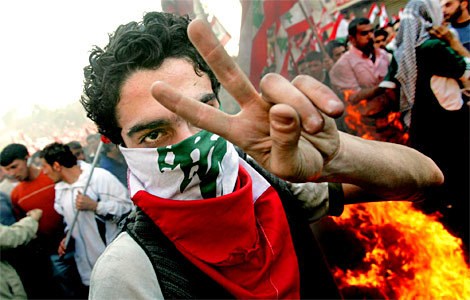
I've been feeling this for a long time. I've never put my finger on it this well. Another example of how secularism has left us defenseless.
Victor Davis Hanson has something of a cottage industry in his exposition of the superiority of the “Western way of war,” and the concurrent proposition that a democratic people once aroused will seek (and generally achieve) annihilation of the foe. There is much to recommend his thesis — but in the absence of the very capacity for moral provocation within a democratic people, it tells us little about our present state. The lesson of our failure to win in this half-decade of war, of which the Israeli failure against Hezbollah is merely the latest example, is that that capacity, if not wholly gone, is severely crippled.
In warring with a religion, decades of secularism have left us utterly disarmed. We are trained to think of faith as either irrelevant or benign: and when it is undeniably malign, we ascribe its malignancy to “fundamentalism,” which is (in direct negation of the meaning of the word) somehow separable or diversionary from the fundamentals of the faith in question. See Andrew Sullivan for a shining example of this self-contradictory foolishness; or worse, see the President of the United States on Islam.
http://joshua.trevino.at/?p=156
Friday, August 18, 2006
Update on A Pastor's Evangelism
Thabiti Anyabwile at Pure Church has an Update on A Pastor's Evangelism. I've appreciated his encouragement for further growth in my life in this area. I hope you feel the same way.
Read on for how you can continue to pray for Thabiti.
On the whole, I'm thankful to the Lord for the grace He has shown me. I'm not there yet, much ground to cover and much grace needed. But here's the progress so far:
1. In the last week and a half I've had extended conversations about the gospel with three different persons. Two of those persons have agreed to meet with me regularly to continue our discussions and to think about how the gospel applies to some issues they're facing.
2. I've been able to complete about 5 or 6 "reverse membership interviews" since settling into the office. And I've been greatly encouraged to do the work of an evangelist as I've heard the wonderful and diverse ways the Lord has worked to bring people to Himself.
3. Thanks to my most able and gracious helpmeet, we now have a dinner appointment with the neighbor for next weekend. Should be an interesting conversation. She seems to be a kind lady--describes herself as Catholic but "likes to bounce around to different churches" (including FBC). Looking forward to the time together. Thanks Kristie!
4. I've found two very competent barbers. Only one professes to not be a Christian. He's also one of the persons with whom I've had good evangelistic conversation. Praying the Lord gives us a continuing relationship and the fruit of conversion.
Read on for how you can continue to pray for Thabiti.
Thursday, August 17, 2006
The Small Church
For good or for bad?
 From Shepherding the Small Church, by Glenn Daman
...
...
 From Shepherding the Small Church, by Glenn Daman
Within the small church, it is not the position that gives power and authority to the individual but the relationships the person has with the other members. Consequently, the pastor is often not the primary leader of the congregation. That role is often given to an individual or individuals who, by their personal interaction with others, influence the rest of the church."
...
This is especially true regarding the vision and direction of the church. Whereas in the large church, the senior pastor sets the direction of the church, in the small congregation the vision must arise from the people themselves. Rather than the pastor being the vision setter, he becomes the vision facilitator, one who helps and coaches the congregation as they set the agenda for the future."
...
The small church is owned and operated by the laity rather than the pastor. Because of this, the pastor is less important to the operation and health of the small church than the larger counterpart. While the pastor may retain the title, the power of the church belongs to the people who have built and operated the church for generations. If the pastor comes into conflict with that authority, then the pastor will often be asked to leave."
NEW Today's Links
 Has anyone seen this? It's on the right side column. All the things that I think are interesting but maybe not worth a post go here. Check it out (so it's not an enormous waste of time).
Wednesday, August 16, 2006
Subscribe to:
Posts (Atom)