Friday, October 20, 2006

Pride as Impatience

2 Good ones on pride in one day... These words from Mark Dever.


I confess that I am sometimes, too often, impatient.

I further confess that as I have meditated on it, it becomes clear to me that this is not a nice, junior kind of sin (at least not in me). It is a disguise for the sin of pride, the ugliest of all sins, and the most direct rejection of God's authority and of a humble joy in His provision for me in the Gospel of Jesus Christ. Let me give you a little of my thinking.

I'm sitting in a meeting. I'm sitting there for hours. The meeting would be no different if I were not there. I might think, or even say to someone, something negative about the meeting, or about "our" needing to be there. (Note, this "our" is a cover; I'm thinking of myself.)

Now, let me question my impatient self at this point. Self, just how important does a meeting need to be before you should spend your time on it. Just how crucial does my role have to be, and how frequently, in order for me to not experience the temptation to impatience.

I know that I have to exercise wisdom and be a good steward of time. But look at how much more you're (I'm) getting at these meetings than I deserve. I deserve Hell! Yet here at this meeting, I'm being cared for. It's not raining on me. My chair is comfortable. There's stuff to drink. And yet, I think that somehow it should take less of my time. As if I deserve more interesting fare for spending MY time; as if I DESERVE anything for the expenditure of my time! My response to such situations should be patience. My tendency is to be patient in situations I like. And that's no patience! Patience is endurance through things that challenge us, and it is rooted in humility, as surely as my impatience is rooted in pride.

I leave you to examine your own impatience. I know that this is one way pride has tried to assume an "acceptable" disguise in my own life, and I'm trying to unmask it. Pray for me.

Fitting Words from Edwards

393. HUMILIATION. That humiliation is grace it appears, because Christ says, "Blessed are the poor in spirit, for theirs is the kingdom of heaven" Matthew 5:3. Now we can understand nothing by the poor in spirit, but those that see their own poverty; that are emptied of themselves; that see they are wretched, and miserable, and poor, and blind and naked; that see that in themselves they are nothing; that are not trusting in any of their own riches, either inward, in any endowments of mind that they have of themselves, or outward, in temporal wealth and honor, etc.; and that are sensible of their great wants. This is meant by the poor spoken of [in]Isaiah 66:2, "But to this man will I look, even to him that is poor," and in Luke 6:20, "Blessed are ye poor" (a parallel place with this in that evangelist), and in abundance of other places in the Scripture; as appears, because by the rich, which in Scripture are spoken of as opposite to these, are meant those that trust in their own riches, either bodily or mental possessions. Matthew 19:24, ["It is easier for a camel to go through the eye of a needle, than for a rich man to enter into the kingdom of God"]. There, [as appears] by the context, by a rich man Christ seems to mean he that trusts in both outward and mental riches, as the rich young man did that was the occasion of Christ's saying thus. Christ explains himself to mean them that trust in riches, Mark 10:24. (In 1 Corinthians 4:8, 'tis evidently meant of trusting in mental riches.) This rich man is set in opposition to this poor man in spirit spoken of in Christ's Sermon on the Mount, as appears by Luke's account of this sermon: Luke 6:24, "But woe unto you that are rich!"

That calm of mind, and hope, and removing of the burden from their hearts they speak of, is an evidence that it is grace, and even of the exercise of faith; it is a rest of soul in submission and resignation to God, in a complacential acknowledgment of his sovereignty and mercy.

'Tis God's manner to give special discoveries of his glory and grace after brokenness of spirit, not only at first conversion but through the whole Christian course. And many have been wont to call their first remarkable discovery of God's grace their conversion, and they perceive that it is generally after such a humiliation; so they make that a distinct work of the Spirit of God, that must necessarily precede conversion.

Wednesday, October 18, 2006

Quick Hitter...

I can try to explain later but the weekly podcast from Ravi Zacharias is worth a listen. He talks about the 3 levels of how philosophy plays out in our lives. Interesting stuff... especially when considering how we can reach this generation.

http://www.rzim.org/

Tuesday, October 17, 2006

No Ordinary People

(ht: Justin Taylor)

It may be possible for each to think too much of his own potential glory hereafter; it is hardly possible for him to think too often or too deeply about that of his neighbor. The load, or weight, or burden of my neighbor's glory should be laid daily on my back, a load so heavy that only humility can carry it, and the backs of the proud will be broken. It is a serious thing to live in a society of possible gods and goddesses, to remember that the dullest and most uninteresting person you talk to may one day be a creature which, if you saw it now, you would be strongly tempted to worship, or else a horror and a corruption such as you now meet, if at all, only in a nightmare. All day long we are, in some degree, helping each other to one or other of these destinations. It is in the light of these overwhelming possibilities, it is with the awe and circumspection proper to them, that we should conduct all our dealings with one another, all friendships, all loves, all play, all politics. There are no ordinary people. You have never talked to a mere mortal. Nations, cultures, arts, civilization--these are mortal, and their life is to ours as the life of a gnat. But it is immortals whom we joke with, work with, marry, snub, and exploit--immortal horrors or everlasting splendors. This does not mean that we are to be perpetually solemn. We must play. But our merriment must be of that kind (and it is, in fact, the merriest kind) which exists between people who have, from the outset, taken each other seriously--no flippancy, no superiority, no presumption. And our charity must be real and costly love, with deep feeling for the sins in spite of which we love the sinner--no mere tolerance or indulgence which parodies love as flippancy parodies merriment. Next to the Blessed Sacrament itself, your neighbor is the holiest object presented to your senses."

—from "The Weight of Glory," in The Weight of Glory (Eerdmans, 1949)

Monday, October 16, 2006

You Fool!


I hope all who read this have come to realize the unexplicable glory of grace, and what I mean is the all surpassing grace of God through Jesus Christ. I have on my right hand a ring, its sole function is to always remind me of that greatest injustice ever perpetrated, and of its claims on my life. That being said I read a passage this weekend that terrifies me.
17 For Christ did not send me to baptize, but to preach the gospel, not in cleverness of speech, that the cross of Christ should not be made void.

And Paul continues:
18 For the word of the cross is to those who are perishing foolishness, but to us who are being saved it is the power of God. 19 For it is written, “I will destroy the wisdom of the wise, And the cleverness of the clever I will set aside.” 20 Where is the wise man? Where is the scribe? Where is the debater of this age? Has not God made foolish the wisdom of the world? 21 For since in the wisdom of God the world through its wisdom did not come to know God, God was well-pleased through the foolishness of the message preached to save those who believe. 22 For indeed Jews ask for signs, and Greeks search for wisdom; 23 but we preach Christ crucified, to Jews a stumbling block, and to Gentiles foolishness, 24 but to those who are the called, both Jews and Greeks, Christ the power of God and the wisdom of God. 25 Because the foolishness of God is wiser than men, and the weakness of God is stronger than men.

I pray that in my pride I do not destroy the essence of the gospel. I pray that my love and humility will stregthen my message and not destroy it. Truly, I'm only beginning to discover the depth of my pride, therefore my foolishness...

Tuesday, October 10, 2006

Religion at 35,000 Feet

This is exactly what Tim Keller was talking about. He mentioned "defeaters." We must address the defeaters. By the grace of God I hope we can tackle this contemporary question. This article is a great testimony to the importance of this issue.

Derek Thomas, a personal testimony:

Don't quit before you get to this:
I saw it coming and did my best to avoid it. “Why can’t we all get along with each other,” she said. “After all, we all believe the same God in the end.” And thus she explained how they raised their daughter to find the truth out there for herself and to encourage whatever it was she embraced so long as it didn’t harm anyone else (which ruled out Islam). “Don’t you agree?” she asked.


What is a guy to say? As a Christian I believe in revealed ethical standards: some things are right and some things are wrong. These are so because God has revealed them to be so. And off I went, trying desperately to explain that there really is only one standard of what is true and what right. And only one way to fellowship with God. I cited John 14:6 and Jesus’s words about being the way, the truth and the life!


And as I spoke, it became clear to her that my view of God was narrow and confined and unaccommodating. And the shutters came down. In her mind, I began to think, I was little different from radical Islam – fundamentally intolerant of the views of others.
Please read more

Thursday, October 05, 2006

Our Fundamentalist Future

Our Fundamentalist Future
By Nathan Busenitz

The year was 1878. Modernism was on the rise, and its attack on the church was full scale.

In response, a group of conservative Bible scholars established a set of fourteen doctrinal principles to outline what they believed was the essence of biblical Christianity. Known as the “Niagara Creed” (because it was associated with the Niagara Bible Conference of 1883–1897), these principles laid the foundation for a movement that would later be called fundamentalism.

On the broader front, the dispensational organizers of the Niagara Bible Conference were joined by non-dispensationalists like B.B. Warfield and J. Gresham Machen in their fight against modernism. In 1910, the fourteen-point Niagara Creed was distilled into “five fundamentals” by the General Assembly of the Presbyterian Church. These five fundamentals were as follows:

(Read On)

Wednesday, October 04, 2006

Martin Luther

I love that each new generation gets the opportunity to discover for itself the treasure of men who point to the glory of Christ.

I greatly longed to understand Paul's Epistle to the Romans and nothing stood in the way but that one expression, "the justice of God," because I took it to mean that justice whereby God is just and deals justly in punishing the unjust. My situation was that, although an impeccable monk, I stood before God as a sinner troubled in conscience, and I had no confidence that my merit would assuage him. Therefore I did not love a just and angry God but rather hated and murmured against him. Yet I clung to the dear Paul and had a great yearning to know what he meant.

Night and day I pondered until I saw the connection between the justice of God and the statement that "the just shall live by his faith." Then I grasped that the justice of God is that righteousness by which through grace and sheer mercy God justifies us through faith. Thereupon I felt myself to be reborn and to have gone through open doors into paradise. The whol of Scripture took on a new meaning, and whereas before the "justice of God" had filled me with hate, now it became to me inexpressibly sweet in greater love. This passage of Paul became to me a gate to heaven...

If you have a true faith that Christ is your Saviour, then at once you have a gracious God, for faith leads you in and opens up God's heart and will, that you should see pure grace and overflowing love. This it is to behold God in faith that you should look upon his fatherly, friendly heart, in which there is no anger nor ungraciousness. He who sees God as angry does not see him rightly but looks only on a curtain, as if a dark cloud has been drawn across his face.

Monday, October 02, 2006

Plenary Session #2

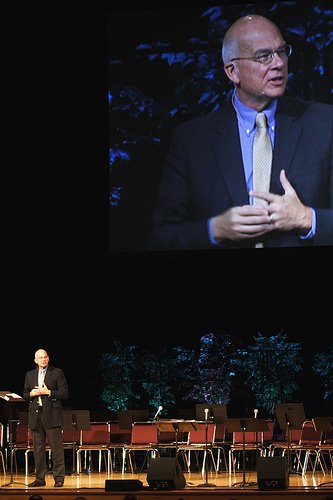
Voddie Baucham could have delivered the best session of the weekend. He spoke on the the Supremacy of Christ in Truth, in a postmodern world. He addressed the four questions everyone asks themselves from two separate perspectives naturalism (post modern) and Christian theism. The four questions he answered were: Who am I? Why am I here? What is wrong with the world? And how can what is wrong be made right? He first discussed these questions from a naturalistic point of view. Who am I is no one. Why am I here is to consume and enjoy. He pointed out the combination of these two can be deadly, "Have we not seen the logical conclusion of this kind of social darwinism?" Furthermore, What is wrong with the world? The naturalist says people are insufficiently educated or insufficiently governed and the answer is more education and more government. Of course who's governing the governors? For the Christian perspective Baucham exposited Colossians 1. Who am I? "You are the crowning glory of the creation of God." Why am I here? The purpose of all things is to bring him glory and honor. "The supremacy of Christ in the very purpose of existance." What is wrong with the world? Baucham said it was me. He illustrated that people often ask him on University campuses how to explain the problem of evil. Baucham tells them he will not answer the question until they ask it the right way, as so: "How on earth can a holy and righteous God know what I did and thought yesterday, and not kill me on the spot." We like to say "how dare God not employ his power on behalf of almighty man... as a result I want a God who is omnipotent but not sovereign." Baucham asked what it would look like if God was sovereign in our lives. I couldn't help but break down to tears as he transitioned from the Supremacy of Christ to the overwhelming conclusion in verses 21-23.

Col. 1:21 And you, who once were alienated and hostile in mind, doing evil deeds, 22 he has now reconciled in his body of flesh by his death, in order to present you holy and blameless and above reproach before him, 23 if indeed you continue in the faith, stable and steadfast, not shifting from the hope of the gospel that you heard, which has been proclaimed in all creation* under heaven, and of which I, Paul, became a minister.


This sermon is a must listen as soon as it's up on www.DesiringGod.org

Sunday, October 01, 2006

Plenary Session #1

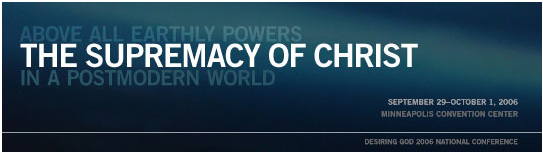
The conference site had no wireless! And I wasn't staying at a hotel. So the result is that the conference blog will be a recap that will last the next few days. I really enjoyed the time. The conference was life changing in many ways. I'll highlight each of the sessions and put some audio up if I can. First, David Wells...

The first plenary session was kicked off with a great session from David Wells. He specifically addressed the Supremacy of Christ from the book of Hebrews. Wells established from the book of Hebrews the incomparable nature of Jesus Christ. The recipients of the book because of the threat of persecution were drawing back from their faith. The author of Hebrews works hard then to establish the Supremacy of Christ to what they wished to hold on to. In essence they were willing to trade “what was unique for what was not, what was completely glorious for what was not.” Wells then suggested we are in such a time. Instead of facing persecution we are facing the curse of the west. Wells said it this way: "We are so distracted by so many things that it is hard for us to sustain this focus on the supremacy of Christ on our work and our lives.” After establishing the supremacy of Christ Wells drew three conclusions. One, he insisted that Christianity is only about “this kind of Christ. Christ reigning supreme, unchallenge and unchallengable over all of life’s enemies. We do not have any message but this.” He continued to say if seekers are looking for something else, we have nothing else to give them. Not only that but he argued doctrine is what people are actually coming to church to receive. Two, Wells argued that we live in the “already but not yet” period of time. He argued that our stage is like a chess match that is already decided but has yet to be play out to its completion. In light of this we ought to always put our pain and perplexities in this bigger context. “These painful experiences that we go through, that sometimes consume us, none of these is the final word. ‘The sufferings of this present time are not worth comparing with the glory that will be revealed to us.’” Finally, he said “It is God’s pleasure that his son should be acknowledged now for who he is.” We are anticipating the time when every knee will bow.

I have to say, the confenece is off to a great start.

Saturday, September 30, 2006

Blogging at the DGNC


I will post more in a bit but the confernce has been unbelievable so far. Voddie Baucham just finished speaking. I have never heard a message so clear and so riveting concerning the supremacy of Christ. Praise God for his ministry. As I left the auditorium, I could do nothing but shake my head and ask why Lord... Why would you lavish your grace on me... When the audio is up (for free) it's a must listen to.

Get the updates on Desiringgod.org

Or Challies is blogging
. He apparently has found more readily accessible internet connections that me...

I have to post some quotes later...

Wednesday, September 27, 2006

Posttraumatic Absentee Father Stress Disorder (PTAFSD)


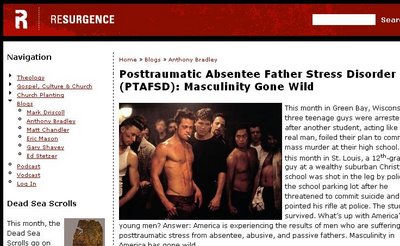
Resurgence talks about Posttraumatic Absentee Father Stress Disorder (PTAFSD): Masculinity Gone Wild
PTAFSD is painfully revisited when the challenges of life hit the fan. Men can’t handle it. They can’t make decisions or commitments. They don’t know how to love women, they are seniors in high school with no idea what to do next or why; or many join the military hoping that their drill sergeant will answer their questions. Distressing longings pervert reality in dreams, fantasies, and memories. Video games, sports, music, material success, and sexual perversion become the only safe havens.

PTAFSD men intentionally and/or inadvertently avoid thoughts, feelings, or conversations that expose deficiencies left by their trauma. These men avoid activities, places, people, opportunities, challenges, and fears that arouse recollections of being improperly fathered. Some men are even pathetically in denial that they are limping. The result: men are posers, they hide, avoid risk, prefer the “indirect approach", won’t lead, won’t take responsibility for their actions, they only choose easy battles.

Some PTAFSD men embrace apathy and fall victim to hopelessness about the future and have marked reduced interest in things God intends to bring men life: having a vocation, fighting sin and evil, caring for creation, living for others, marriage, raising lots of children, exercising leadership, and self-control.

Men suffering from PTAFSD are left to the world of women. Unfortunately, no woman can teach a man how to be a man. In God’s design, masculinity is bestowed from one man to another. Guys with PTAFSD get over-mothered by women who go to their sons for the emotional intimacy needed from husbands. Their sons grow up too fast. Mom keeps him too close, too long, and he becomes a “mama’s boy" destined to look to women for validation. The world of women is his home. He becomes the “nice guy" who cowers to her every wish and desire, and can’t challenge women to become more Godly. Many men, resenting over-mothering, become womanizers: they constantly need as many women as possible to get validation."

Monday, September 25, 2006

Young, Restless, Reformed


(ht: Justin Taylor)

Young, Restless, Reformed, by Collin Hansen

Nothing in her evangelical upbringing prepared Laura Watkins for John Piper.

"I was used to a very conversational preaching style," said Watkins, 21. "And having someone wave his arms and talk really loudly made me a little scared."

Watkins shouldn't be embarrassed. Piper does scare some people. It's probably his unrelenting intensity, demanding discipline, and singular passion—for the glory of God. Those themes resound in Desiring God, Piper's signature book. The pastor for preaching and vision at Bethlehem Baptist Church in Minneapolis has sold more than 275,000 copies of Desiring God since 1986. Piper has personally taken his message of "Christian hedonism" to audiences around the world, such as the Passion conferences for college-age students. Passion attracted 40,000 students outside Memphis in 2000 and 18,000 to Nashville earlier this year.

Not all of these youth know Piper's theological particulars. But plenty do, and Piper, more than anyone else, has contributed to a resurgence of Reformed theology among young people. You can't miss the trend at some of the leading evangelical seminaries, like Trinity Evangelical Divinity School, which reports a significant Reformed uptick among students over the past 20 years. Or the Southern Baptist Theological Seminary, now the largest Southern Baptist seminary and a Reformed hotbed. Piper, 60, has tinged the movement with the God-exalting intensity of Jonathan Edwards, the 18th-century Puritan pastor-theologian. Not since the decades after his death have evangelicals heaped such attention on Edwards."

Read on...

Tuesday, September 19, 2006

Aesthetics

(ht: Dr. Paul Hartog)

Just finished. This is a must read if you care about Aesthetics: William Edgar's article on Aesthetics. A small section:

In their own way, evangelical Christians have joined the opposition to aesthetics. The most common form is a pragmatism, which argues that evangelism is prior to cultural pursuits. There are many variants on this. Fundamentalists, for example, present a fascinating paradox. Some identify artistic pursuit with worldliness, and thus center the discussion on boundaries: May we go to the movies? May we play folk music in church? Can a Christian be a professional actor? Others would allow pursuing artistic endeavors, indeed they would celebrate them, on condition that they be 'excellent.' Here, the discussion is centered on questions of artistic merit: is not classical music the only legitimate kind? Should not our museums feature only the great masters? Ironically, though, both sides of the fundamentalist approach neglect deeper aesthetic concerns. The first eschews them, the second contains them in a small 'highbrow' box."

Monday, September 18, 2006

What Questions are We Asking Today?


By Gary Shavey at the Resurgence

ht: The Resurgence
As I continue to read the array of emerging and/or emergent information that seems to be floating around in web space, I have come across a couple of thoughts. These thoughts have to do with some basic philosophy (mind you I do not hold a Ph.D. in philosophy so this would be very elementary). In philosophy we have two categories of questions. The “first-order questions” which have to deal with the "is" or state of the world, how things happen in the world or what should we do or find in the world. Then the other category are the “second-order questions” which are basically the questions on how we got to an answer for the first-order questions or how we tell our thoughts or answers in today’s language. Again from my limited understanding of philosophy it seems that philosophers today have focused more on the second-order questions of how our thoughts are expressed in language.

This all seems so interesting to me because most of these second-order questions have bled into the post-modern ways in which we are trying to do church or preach the gospel today. There seems to be a lot of talk on the second-order questions which really only interest people that are asking the second-order questions. Usually this means people that actually study philosophy or people that are trying to be overly intellectual. But what I see in the church and outside the church with people living in time and space are people asking more first-order questions. People are asking about their plight in life, about what the world is really about and what should we do in this life. Here the church has to respond in first-order answers but it seems to me that a lot of the “dialogue” (predominately heard in the more emergent church) comes back in second-order answers.

My question for those who would like to respond is, do you see in your missional life more first-order or second-order questions from believers to non-believers?

Thursday, September 14, 2006

What's Joel Osteen All About

I hope you are all up for some negativity this morning. And I also hope I say what I love as much as what I hate. This is a little excerpt from Joel Osteen's podcast today. He begins each service with leading everyone in the service in reciting this little chant.

This is my Bible. I am what it says I am. I have what it says I have. I can do what it says I can do. Today I will be taught the word of God. I boldly confess, my mind is alert, my heart is receptive, I will never be the same. I am about to receive the incorruptible, indestructible, ever living seed of the word of God. I will never be the same, never never never, I’ll never be the same, in Jesus name.”

The message that followed was thoroughly corrupt. Osteen mentioned in passing two scripture references. His whole message was about “going higher,” fullfilling your potential. The prosperity gospel is at the center of his teaching. What I did find curious was in his twenty-six minutes of moralizing how many similarities I could find between his teaching and the revivalistic right wing fundamentalists. I was surprised by this. They both tend to be very specific in application and very spotty in biblical exegesis. They even employ the same crowd moving schemes of rhetoric. Finally, Osteen tacked this on to the end of his message.

We never like to close our broadcasts without giving you an opportunity to make Jesus the Lord of your life, would you pray with me today. Just say, Lord Jesus I repent of my sins, I ask you to come into my heart, was me in you blood, I my Lord and Savior. Friends, if you prayed that prayer, I believe you got born again. Get in a good Bible based church. Keep God first place in your life. We love you, we’ll be praying for you. I hope you join us at this same time next week.”

This message having been preceded by no mention of the gospel of Christ is exactly what the church does not need.

Wednesday, September 13, 2006

Links

Life's been a blur the last two weeks so just a couple of links to peek your interest.

First (ht: Between Two Worlds)
Darrell Bock, NT professor at Dallas Theological Seminary, has begun a series of blog posts on the Emergent/emerging church movement. If you're interested in such things, you may want to keep an eye on his site. See part 1 and part 2.

Second (ht: Albert Mohler, Does God Want Us to Be Rich?)
Theological confusion takes many forms, but with this cover story, TIME directs us to one of the most pervasive perversions of the Christian Gospel in our times -- prosperity theology. The article, written by David Van Biema and Jeff Chu, is fair, balanced, and devastating.
More...

Sunday, September 10, 2006

Pastoral Ministry

Charles Jefferson decries the lack of appreciation for "pastoral ministry." He says the following:
One result of this disparagement of pastoral service is visible in the sentiments entertained by many young men entering the ministry. They say quite openly that they despise pastoral work. Study they enjoy, books they love, preaching they revel in. But as for shepherding the sheep, they hate it. They like to feel that they have special gifts for the pulpit. When their friends prophesy for them a glorious pulpit career, their heart sings. The work of the shepherd was an abomination, we are told, to the ancient Egyptians, and so it is to all the pulpit-Pharaohs who are interested in building pyramids out of eloquent words. The fear of ailing in pastoral duty is never once before their eyes. A slip in the pulpit brings gnawing remorse; a blunder in pastoral work gives the conscience not a twinge. Public worship is to them the be-all and end-all to ministerial life. They have not read the New Testament sufficiently to observe that public worship is not made the one thing needful, either by Jesus or the apostles; and that while it is not to be neglected, there are many weightier matters of the law.
Charles Jefferson, The Minister as Shepherd, pg. 24

I'm am certain, as unpleasant as it may be, at times it is healthy to read things that I strongly (and negatively) react to by nature. When I first read this paragraph I was angry at the characterization of young men. In my pride, I miss the point. This is a good reminder I think.

Thursday, September 07, 2006

Pinocchio has Converted


(ht: Albert Mohler)

The Telegraph is reporting that Pinocchio has become a muslim. Here's what Al Mohler has to say about it.

Where will this end? What if Huckleberry Finn becomes a Buddhist? ["Honest, Injun Joe, all I desire now is the absence of all desire. Honest"] What if Aunt Polly becomes a Christian Scientist? ["Don't worry about that gunshot dear, pain and illness are only illusions."] What if Jiminy Cricket becomes a Zoroastrian? It would give "When You Wish Upon a Star" a whole new meaning.

The literature of the West acknowledges the existence of non-Christians. The literature of the Islamic world does not acknowledge the existence of non-Muslims in the same way. Pinocchio must convert. That is a distinction worth reflection."